



Trigunas are the three basic qualities of nature-Sattva (stability), Rajas (exercise), and Tamas (inertia)-through which Prakriti expresses matter, thoughts, and character.
Ayurvedic philosophy presents a transparent view of how the universe comes into existence, from which the idea of Trigunas Tri that means three and Gunas that means qualities naturally arises.
Based on Ayurveda, originally of creation there was an unmanifest state usually described as darkness. This state represents the presence of Purusha (pure consciousness) and Prakriti (primordial nature). The universe comes into being by the union of those two rules, symbolically understood because the masculine and female points of creation.
Prakriti expresses itself by all types of existence-gross and delicate, residing and non-living-while Purusha offers the presence of consciousness that offers life and motion to matter.
In Samkhya philosophy, each Purusha and Prakriti are summary realities. Purusha stays unchanged, passive, and witnessing, whereas Prakriti is lively, dynamic, and constantly remodeling. From this interplay of stillness and motion, the Trigunas emerge as the basic qualities governing nature.
What are trigunas?
Prakriti expresses itself by three basic qualities, referred to as the Trigunas or the three qualities of nature. These gunas govern how matter, vitality, and consciousness seem and performance within the universe.
The phrase Prakriti itself displays this threefold nature:
- Pra means Sattva Guna
- Kr means Rajas Guna
- Ti means Tamas Guna
These three gunas by no means act independently. They mix in numerous proportions to present rise to the 5 parts (Pancha Mahabhutas) that type the idea of the physique and the fabric world.
Trigunas and the 5 parts
| Triguna / Mixture | Predominant Aspect |
|---|---|
| Sattva | Akasha (Ether) |
| Rajas | Vayu (Air) |
| Sattva + Rajas | Agni (Hearth) |
| Sattva + Tamas | Jala (Water) |
| Tamas | Prithvi (Earth) |
These 5 parts additional mix and work together to type the three doshas (Vata, Pitta, and Kapha), which regulate all physiological and psychological features within the physique.
By means of these parts and doshas, the Trigunas prolong past the physique and grow to be the delicate forces that form the thoughts, behaviour, and character of a person.
Traits of the three gunas
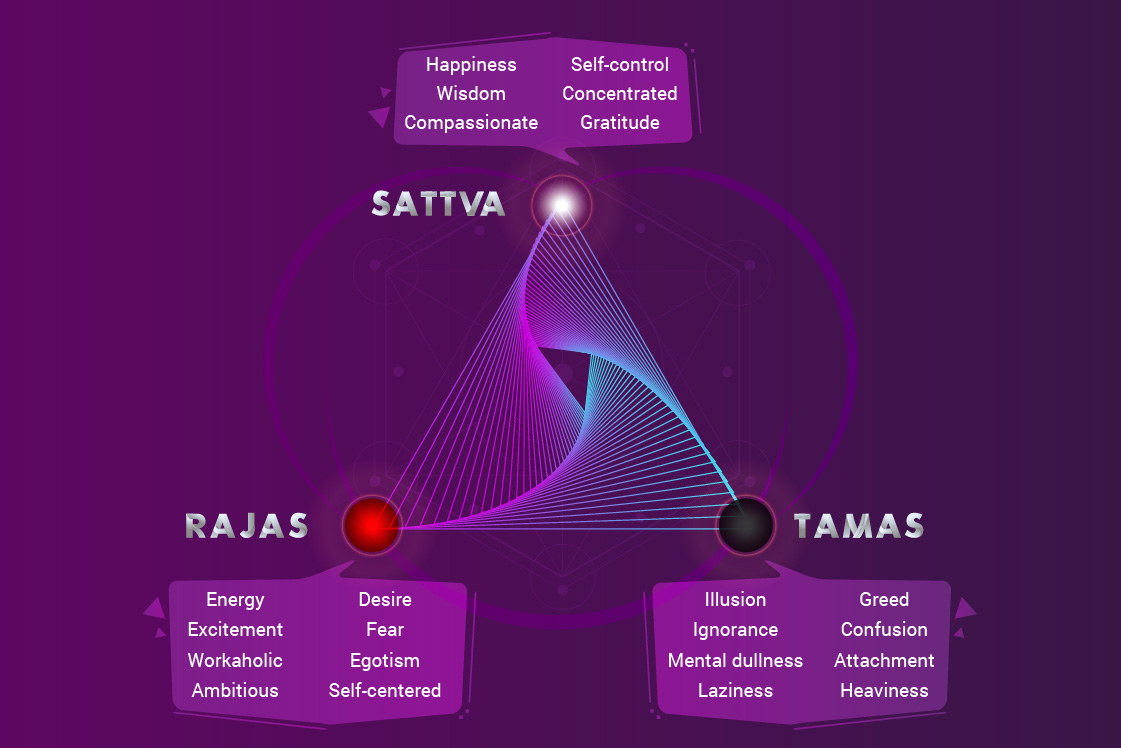
Go searching and in addition inside your self each residing and non-living factor carries the affect of the Trigunas.
Motion on this planet, such because the circulation of blood or the fixed exercise in nature, happens because of the presence of Rajas Guna, the standard of motion and movement.
When you’ll be able to decelerate or momentarily cease the fluctuations of the thoughts throughout meditation, this stillness is supported by Tamas Guna, which offers stability and relaxation.
In distinction, when the thoughts constantly jumps from one thought to a different, Rajas Guna turns into dominant.
Throughout deep meditation, when consciousness turns inward and a way of calm pleasure arises, this expertise displays the presence of Sattva Guna, the standard of stability and readability.
The Trigunas function in all places and in any respect times-within the physique, the thoughts, and the encircling world.
Sattva guna traits
Sattva represents a balanced state between exercise and inertia. When Sattva is predominant, the thoughts and physique operate with concord and readability.
Widespread traits of Sattva Guna embody:
- Happiness and interior peace
- Knowledge and religious consciousness
- Compassion and kindness
- Lightness of physique and thoughts
- Self-control and focus
- Gratitude and selflessness
Sattva Guna is historically related to the color white, symbolising purity and stability.
Rajas guna traits
Rajas Guna is the standard of motion, ardour, and stimulation. It’s accountable for motion, need, and alter.
Traits of Rajas Guna embody:
- Robust needs and attachments
- Ambition and enthusiasm
- Restlessness and agitation
- Workaholic tendencies
- Nervousness, anger, and emotional turbulence
Rajas Guna is symbolised by the color purple, representing vitality and depth.
Tamas guna traits
Tamas Guna is the standard of inertia and resistance. Whereas it offers grounding and relaxation, extra Tamas results in stagnation.
Traits of Tamas Guna embody:
- Psychological dullness and confusion
- Laziness and lack of motivation
- Ignorance and phantasm
- Attachment and heaviness
Tamas Guna is related to darkness, reflecting obscurity and inactivity.
Trigunas and character
Chances are you’ll usually hear somebody described as having a “good” or “robust” character. In yogic and Ayurvedic thought, character is known extra deeply because the expression of the Trigunas appearing by the thoughts.
In classical philosophy, the Trigunas are the basic attributes of human existence. They form each the fabric and delicate points of an individual. Relying on their proportion, these three qualities affect how a person thinks, reacts, understands conditions, and pertains to the world.
The Trigunas do not stay fastened. Their dominance modifications with bodily situation, psychological state, life-style, and setting. Trendy research have additionally noticed that inherited guna tendencies can shift underneath psychological, social, and environmental influences, thereby affecting behaviour at a given time.
Because the proportion of Sattva, Rajas, and Tamas rises or falls, corresponding modifications seem in character traits, attitudes, and patterns of behaviour. Thus, character shouldn’t be static—it’s a dynamic reflection of the Trigunas at work.
How trigunas form character
Any bodily, psychological, or psychological change in a human being has its foundation within the 5 parts that compose the physique. These parts are skilled by the 5 senses, which constantly collect info from the exterior world.
The sensory impressions collected by the senses go inward first to the thoughts, then to the mind (Buddhi). At this stage, the impressions are interpreted and modified in line with the dominant Guna current at that second.
Because of this, the Guna turns into the ultimate influencing issue within the formation of character.
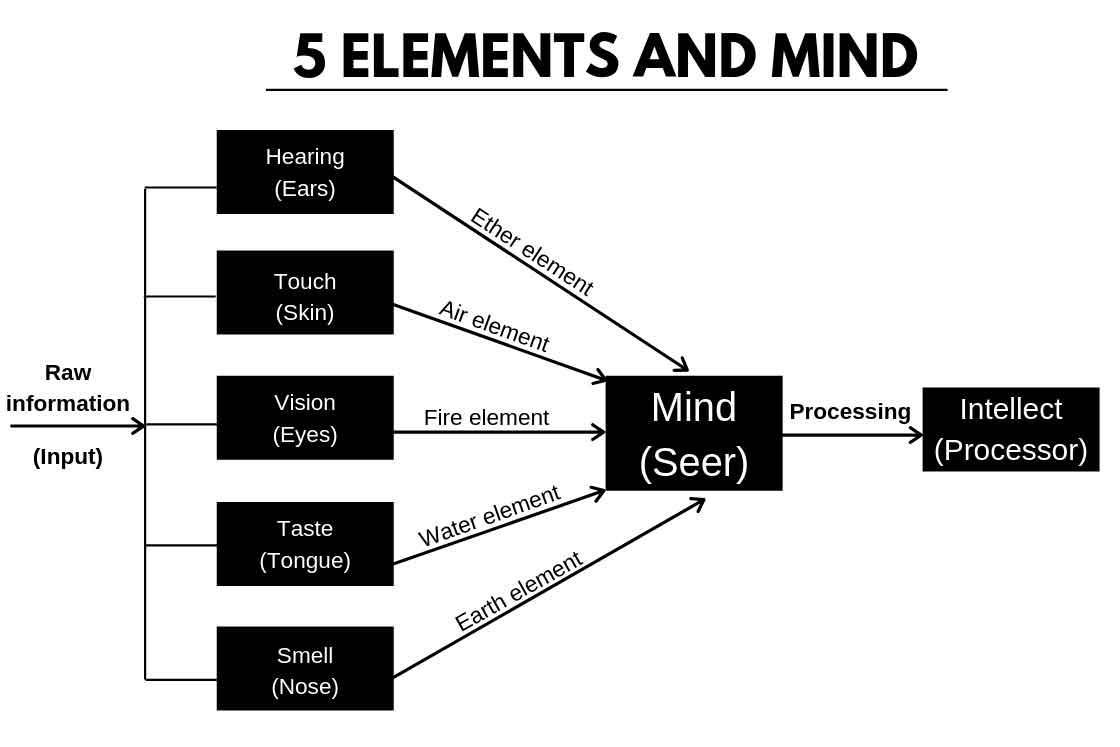
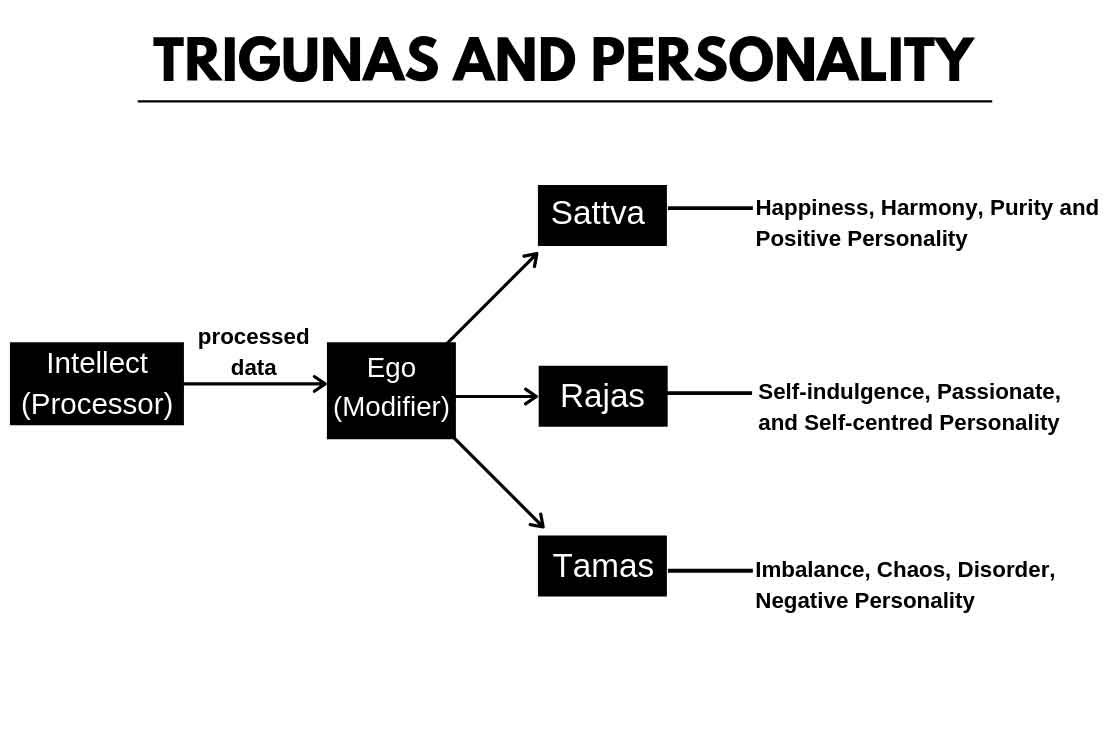
Each particular person perceives experiences by a way of I or ego (Ahamkara). This ego acts as a modifier, colouring notion and response. As illustrated earlier, the Trigunas function by this ego precept and decide how ideas, feelings, and reactions take form.
In the end, what emerges from uncooked sensory enter is recognised as an individual’s character, and it displays the Triguna or mixture of Trigunas that’s dominant at a given time.
The individual with sattva guna
Sattva means purity and readability. When Sattva Guna is dominant, it displays a character that’s naturally inclined in direction of stability, consciousness, and moral residing. This high quality helps kindness, care, and a honest reference to increased values, giving rise to a Sattvic character.
Sattva Guna is current in a wholesome proportion when an individual reveals the next qualities:
- Psychological power and stability
- Respect for academics and guides (Gurus)
- Non-violence in thought and motion
- Kindness and goodwill in direction of others
- Self-control and self-discipline
- Curiosity in meditation and self-reflection
An individual with dominant Sattva Guna performs work and duties with calmness and readability, clearly distinguishing between what’s fascinating and undesirable. Selections are guided by understanding moderately than impulse.
As Sattva will increase, one turns into extra drawn in direction of love, compassion, kindness, and lasting happiness. This balanced state helps each psychological and bodily well-being and is historically related to good well being and concord.
Classical texts additional describe seven sorts of Sattvic personalities, primarily based on delicate variations inside Sattva itself.
The individual with rajas guna
An individual dominated by Rajas Guna is pushed by need, motion, and attachment to outcomes. Such people are energetic and bold, however robust self-interest can typically make it tough to obviously distinguish between proper and improper. This sample of behaviour is named a Rajasic character.
Rajas Guna is current in a balanced proportion when an individual reveals the next qualities:
- Enthusiasm and drive
- Deep involvement in work
- Dedication and dedication
- Restlessness and fixed exercise
- Robust sense of individuality
- Want for achievement
The time period Rajas refers to ardour and motion. It lies between Sattva and Tamas and acts as a catalyst or bridge between the 2. By means of Rajas, the soundness of Tamas is reworked into motion, and the readability of Sattva is expressed by effort. On this manner, Rajas helps motivation, creativity, change, and purposeful motion.
When Rajas Guna turns into imbalanced, its extreme dominance can result in agitation, anger, anxiousness, impatience, and an unhealthy attachment to outcomes.
The individual with tamas guna
Tamas means darkness and heaviness. It represents a psychological state marked by phantasm, ignorance, dullness, and inactivity. When Tamas Guna is dominant, it offers rise to a Tamasic character, usually expressed by selfishness, lack of sensitivity, indifference, and a pessimistic outlook.
When Tamas begins to cut back and transfer in direction of stability, optimistic modifications could be noticed, resembling:
- Well timed and restful sleep
- A extra balanced method to meals
- Better openness in direction of others
- An appreciative and receptive angle
- Rising concern for the well-being of others
- Willingness to behave and provide assist
When Tamas Guna is imbalanced or extreme, it might result in short-lived pleasure searching for, materialism, possessiveness, confusion, and damaging tendencies. Such a state retains the thoughts trapped in inertia and prevents readability and development.
A guide
A classical reference to this understanding is discovered within the guide Dhanwantri: A Full Information to Ayurvedic Life, written by Harish Johari, the place people are categorised into seven character varieties primarily based on the dominance and mixture of the Trigunas.
These seven varieties are:
- Individuals with dominant Sattva Guna
- Individuals with dominant Rajas Guna
- Individuals with dominant Tamas Guna
- Individuals with a Sattva–Rajas Guna mixture
- Individuals with a Sattva–Tamas Guna mixture
- Individuals with a Rajas–Tamas Guna mixture
- Individuals with balanced Gunas (Sattva–Rajas–Tamas in concord)
This classification highlights an important precept: the Trigunas by no means exist in isolation. They at all times operate collectively, usually influencing and competing with each other. At any given time, the dominant Guna determines behaviour, tendencies, and character expression.
By this stage, it’s possible you’ll already recognise which Guna or mixture of Gunas most intently displays your individual nature.
This naturally results in an necessary query:
How can we consciously work with the Trigunas inside ourselves for our personal well-being and for the good thing about others?
Learn how to stability the trigunas in each day life
The Gunas aren’t bodily substances, but their presence is clearly recognised by three points of human behaviour:
- Motion we carry out
- Intention behind the motion
- Response to its end result
By changing into conscious of those three, one can consciously work in direction of balancing the Gunas inside.
Motion and intention
All motion is universally engendered by the attributes (gunas) of primordial nature (prakriti). A person whose self is deluded by egoity thinks, “I’m the doer” – Bhagavad Gita 3:27
Each motion begins with an intention. To recognise the Guna influencing an motion, it’s useful to mirror on two questions:
- Why I’m doing this? (Intention)
- How I’m doing this ? (Manifestation)
At sure levels of life, an motion might come up from a Sattvic intention, whereas its execution might carry Rajasic or Tamasic qualities.
For instance, an individual might steal to offer for his or her household. On this case, the intention (supporting family members) might comprise Sattva, however the technique of motion is Tamasic. Because of this, Tamas turns into the dominant Guna.
By fastidiously observing each intention and motion, one can start to know which Guna is prevailing and the way it could also be refined.
Response
The response to the results of an motion performs an important position in shaping one’s interior nature. What we dwell upon after appearing is what continues to develop inside us.
Returning to the identical instance, if the individual displays upon the act of stealing with regret, sorrow, or interior battle, this response signifies the presence of Sattva throughout the intention. Such contemplation, although tough, holds the potential to progressively remodel Tamasic tendencies into readability and consciousness.
Thus, by aware commentary of motion, intention, and response, the Gunas could be understood, regulated, and introduced into larger stability.
Rajas Guna: A step from tamas to sattva
Many individuals naturally purpose to extend Sattva Guna, associating it with purity and religious development. In doing so, they usually overlook the significance of sustaining a balanced state of all three Gunas. The yogic method is to not favour one high quality excessively, however to permit every Guna to operate in concord.
An extreme rise in Sattva might result in delicate religious pleasure. Extreme Rajas can lead to greed, restlessness, and overwork, whereas dominance of Tamas offers rise to ignorance and inertia. Due to this fact, stability not suppression is the important thing.
The sensible technique is to first remodel Tamas into Rajas, after which progressively refine Rajas into Sattva.
Tamas to Rajas
When Tamasic qualities resembling laziness, dullness, low temper, anxiousness, or irritability dominate, the treatment lies in motion and engagement.
This shift could be supported by:
- Practising bodily yoga asana
- Protecting the corporate of optimistic and lively individuals
- Travelling or altering environment
- Consuming mild and nourishing meals
These actions assist elevate vitality from inactivity to exercise, permitting Rajas Guna to interchange stagnation.
Rajas to Sattva
When exercise, enthusiasm, and restlessness improve, it signifies the predominance of Rajas Guna. At this stage, vitality is out there however requires refinement.
To information Rajas in direction of Sattva, one might interact in:
- Meditation and inward reflection
- Studying and examine of uplifting information
- Selfless or charitable actions
- Observance of moral disciplines such because the Yamas, which assist regulate extra vitality
By means of these practices, stressed exercise is progressively reworked into readability, stability, and interior stability.
Conclusion
The idea of the Trigunas Sattva, Rajas, and Tamas presents a transparent framework for understanding how nature, thoughts, and character operate. These three qualities aren’t fastened traits, nor do they exist in isolation. They constantly work together, rise, and fall, shaping behaviour, notion, and interior tendencies at each stage of life.
By means of consciousness of the Gunas, one begins to recognise the forces behind ideas, actions, and reactions. This understanding doesn’t purpose to suppress any high quality, however to convey them into stability. Tamas offers stability, Rajas allows motion, and Sattva presents readability. When harmonised, they help bodily well-being, psychological readability, and religious development.
By observing each day actions, intentions, and responses, and by adopting acceptable yogic practices, it turns into doable to progressively refine the Gunas. On this manner, the knowledge of Trigunas serves not solely as a philosophical idea, however as a sensible information for residing with consciousness, stability, and interior concord.

