


Our articles will not be designed to switch medical recommendation. If in case you have an harm we advocate seeing a certified well being skilled. For extra data see out Phrases and Circumstances.
I’ve had some nice questions despatched in following our first Q&A mode weblog. I’m going to cowl 2 extra immediately; how one can prescribe of plyometrics and when to introduce gait evaluation and retraining.
Query 1, from Maria
“One factor I wrestle with within the rehabilitation course of is the build-up of plyometrics (which workouts, what number of repetitions, relaxation in between units). Perhaps this could possibly be a part of considered one of your newsletters?”
I can empathise with Maria right here, plyometrics may be difficult to plan and embody inside rehab so I’m going to take you thru 3 stage strategy to supply some steering.
It’s impressed by the work of Eamonn Flanagan and others and I’d extremely advocate listening to this Sportsmith podcast with Eamonn the place he goes by plyometrics in additional element.
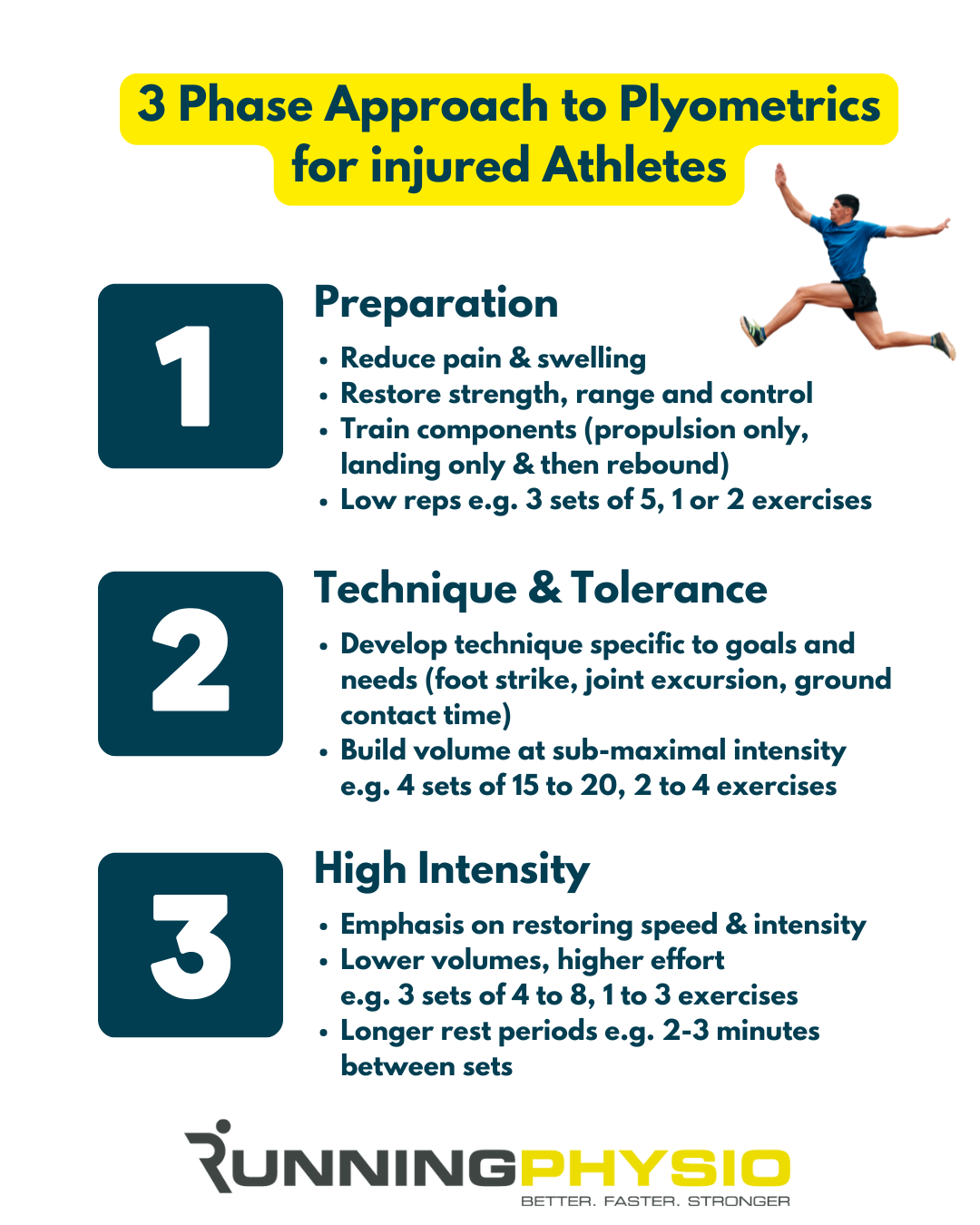
Right here’s my 3 stage strategy to plyometrics for injured athletes:

These levels could overlap and a few athletes might be able to are available in at part 2 or 3 so we have to adapt it to swimsuit the person. Let’s develop slightly on every part:
Preparation
In early rehab, we need to cut back ache and guarantee it’s a protected and acceptable time to introduce influence by way of the person, their harm and its stage of therapeutic. Energetic swelling, irritable signs or lack of joint vary are often indicators that somebody isn’t prepared for plyometrics so should be addressed first.
Plyometrics are sometimes used to enhance energy. Energy = Pressure x Velocity so it’s a mix of energy and pace. In a nutshell, it’s arduous to be highly effective in case you’re not sturdy!
Construct energy is a key a part of the preparation for plyometrics and energy. It could enhance plyometric capability by itself. Kirwan et al. (2024) demonstrated this in sufferers with Achilles Tendinopathy. Their hopping capability elevated considerably following an eccentric loading programme despite the fact that no energy/ plyometric work was included.
We could select on this part to work on the elements of plyometrics to enhance confidence and introduce influence at a manageable degree. This might embody engaged on simply the propulsive part and simply touchdown and cargo absorption earlier than occurring to incorporate the ‘rebound’. Right here’s how we would do that with bounding:
- Propulsion – take off on the injured leg and land on the wholesome leg
- Load absorption – take off on the wholesome leg and land on the injured one. Management the touchdown however don’t take off once more.
- Rebound – take off on the injured leg, land on the wholesome leg and rapidly rebound to land as soon as once more on the injured leg. Repeat so each legs are uncovered to take off, touchdown and rebound.
Usually, these can be low depth (e.g. small bounds, comparatively low effort) and low quantity initially to make sure they aren’t provocative. For instance, I would recommend 3 units of 5 reps initially with simply 1 or 2 workouts. I typically think about the instructions concerned within the sport so the two workouts may be 1 with extra vertical forces (e.g. squat jumps or skipping in place) and 1 with extra horizontal forces (ahead jumps or bounds).
Approach and Tolerance
If an athlete is managing part 1 nicely with out symptom response, we will typically progress onto part 2. The main focus right here is constructing influence tolerance with increased volumes of plyometrics with the specified method.
The depth is elevated barely, nevertheless it stays sub-maximal effort (a time period Eamonn makes use of lots in his podcast above). There doesn’t appear to be a ‘gold commonplace’ by way of quantity throughout the literature and there’s a lot of selection. Silbernagel et al. (2007) had only one energy train of their Achilles Tendinopathy rehab programme – 3 units of 20 fast rebounds. In contrast, Sancho et al. (2019) embody increased volumes of their Achilles rehab protocol, together with some workouts with 3 units of 60 jumps:

Picture Supply: Sancho et al. (2019)
There seems to be some selection in additional performance-focused research too. Latest work by Engeroff et al. (2023) progressed from 5 units of 10 hops to fifteen units of 10 and included very quick relaxation intervals:

Picture Supply: Engeroff et al. (2023)
That is in marked distinction to Beattie et al. (2017) who additionally focussed on 1 train in a session, however at a lot decrease volumes, sometimes 4 units of simply 3 to five reps. So I can definitely perceive the place the confusion comes from!
If we pause a minute and think about the widespread state of affairs a runner could also be in after we introduce plyometrics it might probably assist – often, it’s mid to end-stage rehab, they’ve a energy plan which they’re combining with a return to working programme and we’re including plyometrics to the combo too!
So I are likely to assume much less is extra and the increased the depth of the plyometrics the decrease the quantity and the longer the remaining interval is required.
On this part the place it’s nonetheless sub-maximal depth, we would go for barely increased volumes, equivalent to 4 units of 15 to twenty reps with 2 to 4 workouts however we’d be guided by the person, their expertise, targets and symptom response.
The opposite facet we think about right here is desired method. It’s finest to handle this at decrease intensities. There are few ‘gold requirements’ for plyometric methods that may swimsuit each particular person so we’re typically contemplating how we would modify the motion to affect load on injured/ delicate tissues.
For instance, a runner with Patellofemoral ache who tends to come back into deep knee flexion throughout plyometrics which we’d anticipate to extend PF joint load. We would encourage a barely shorter floor contact time to assist handle this.
In contrast, post-ACL surgical procedure sufferers typically keep away from loading into knee flexion throughout working and influence and this will result in elevated motion on the hip, trunk and pelvis or elsewhere within the kinetic chain. Right here we would concentrate on a barely softer touchdown permitting extra motion on the knee.
Excessive Depth
As soon as a affected person has constructed up some quantity at sub-maximal depth with desired method we will intention to extend the depth of the plyometrics. This may sometimes be with decrease volumes and longer relaxation intervals, for instance, 3 units of 4 to eight reps with 2-3 minute relaxation between units, 1 to three workouts in complete.
The main focus is on pace and explosive intent, sometimes with quick floor contact occasions. That is typically what individuals could think about extra ‘true plyometrics’. There are many train choices to think about right here together with squat jumps, field jumps and countermovement jumps, skipping, bounding, hill bounding, pogos, hops in place, ahead hops and so forth.
Contemplate the protection elements and the calls for of the game by way of floor, path, exterior load, double leg v single leg and method. As with every facet of what we do it would come right down to a reasoning course of not a recipe.
Athletes with extra expertise of plyometrics and non-irritable signs could handle increased volumes/ intensities whereas extra advanced instances which were liable to flare up with elevated load will want a extra cautious strategy.
Query 2, from AJ
“My query revolves round managing injured runners (runners who’re presently having ache and needing to change their quantity/depth). At what level do you implement gait retraining when harm is the problem and the purpose isn’t simply efficiency/working financial system? Secondary query, would then be what are the 2-3 most typical gait “faults” you see and your instructed retraining/cueing to enhance them?”
One other good query!
Usually, I have a tendency to incorporate gait evaluation at round session 3 or 4 with a runner. That’s as a result of in session 1, I need to guarantee coaching is at a manageable degree, now we have some rehab workouts in place, and the runner understands the harm and how one can handle it. In session 2 we regularly must fine-tune this slightly to make sure each the working and rehab are on the proper degree. As soon as that is the case, they’ll want a while to use the plan, so periods 3 or 4 are sometimes a very good level to evaluate gait.
Signs and levels of harm will information us too. Usually, a runner wants to have the ability to tolerate at the least 5 minutes of working at most popular tempo with minimal signs. If their ache is just too irritable or it’s too early of their restoration, then they are going to typically compensate of their gait, and the evaluation can worsen signs.
The two most typical gait elements we handle are over-striding and ‘medial collapse’ (slender gait with pelvic drop and elevated hip adduction).
If step fee is low, then growing it by 5 to 10% by working to the beat of a metronome might help each of those patterns. Alternatively, a cue like ‘don’t let your knees contact’ may be very worthwhile for elevated hip adduction/ medial collapse.


