

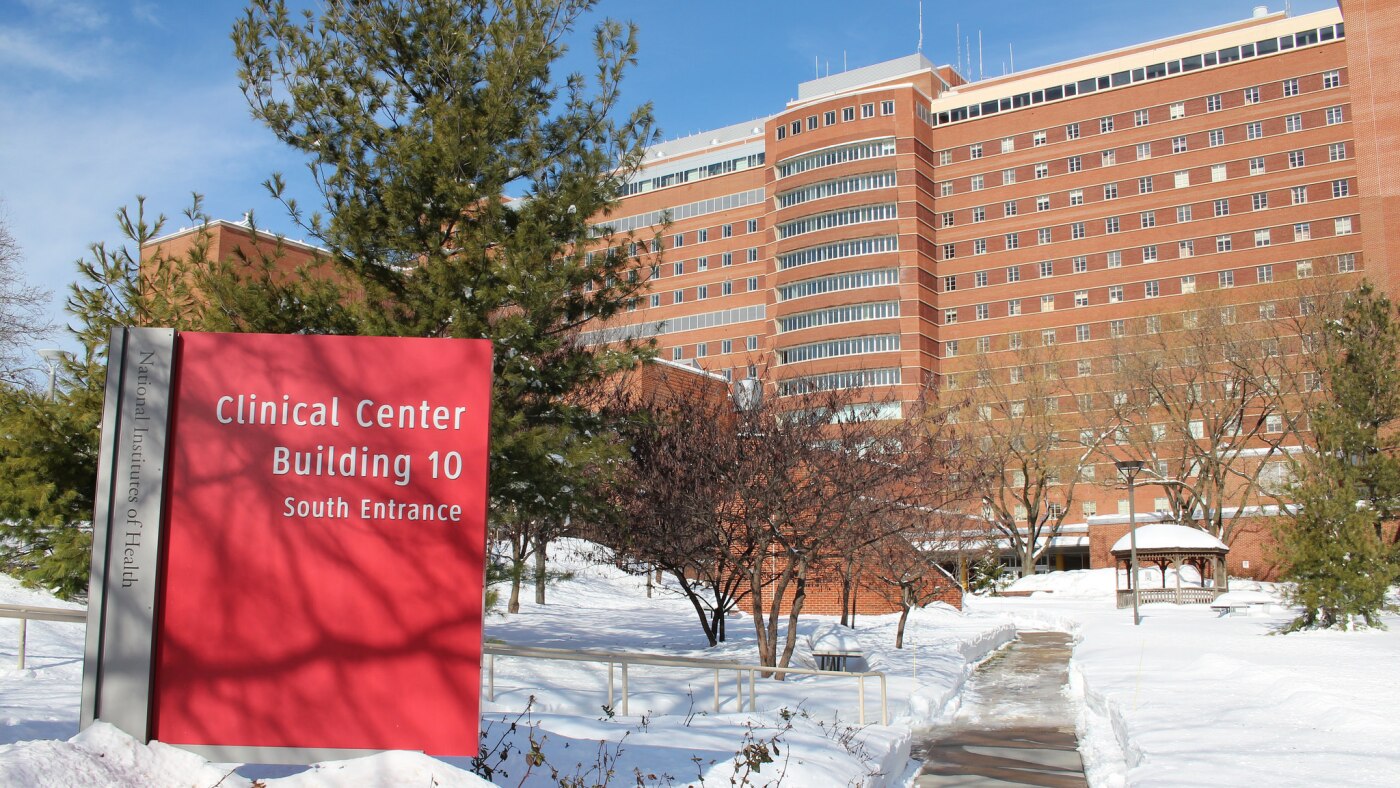

Medical analysis carried out on the Nationwide Institutes of Well being campus in Bethesda, Md., continues however recruitment of recent sufferers is on maintain.
Nationwide Institutes of Well being
cover caption
toggle caption
Nationwide Institutes of Well being
As President Trump takes the reins of the federal authorities, one of many companies in turmoil is the Nationwide Institutes of Well being — the world’s main public funder of biomedical analysis.
The brand new administration imposed a blackout on the NIH and different well being companies on most communications with the skin world and banned journey, forcing the cancellation of conferences wanted for choices about what analysis to fund subsequent within the fights in opposition to most cancers, coronary heart illness, diabetes and different ailments.

These strikes, amongst others, have generated widespread confusion, anxiousness and concern amongst scientists and medical doctors on the sprawling NIH campus exterior Washington, D.C., and at establishments depending on the company’s funding.
“It is an enormous deal,” says Haley Chatelaine, a postdoctoral fellow finding out primary mobile features on the NIH who helps discount for the union representing 5,000 NIH fellows. She was one in all only a few NIH staff keen to talk on the document with NPR.
“Science strikes at breakneck speeds. And requires that each one of us within the scientific neighborhood work collectively,” Chatelaine stated. “Any hole that we expertise units us again by way of with the ability to conduct the leading edge biomedical analysis that People want to remain wholesome.”
Communications clampdown, however indicators of a thaw
The NIH launched a press release Monday evening saying the communications blackout has began to elevate and a few conferences and journey are resuming. The NIH has restarted closed periods of committees topic to the Federal Advisory Committee Act, which incorporates advisory councils and boards and scientific evaluation teams.
As well as, the NIH has lifted a block on submissions to the Federal Register, official correspondence to public officers and journey “in help of NIH inner enterprise for oversight and/or conduct of science,” based on the assertion.
However a hiring freeze on the NIH stays in place, together with a prohibition on beginning any new analysis initiatives on NIH’s campus, and a pause on recruiting new sufferers for any medical research on the company.
“It is extremely irritating,” says Marjorie Levinstein, one other postdoctoral fellow at NIH with the union. She research dependancy amongst different issues and says she needed to put apart a giant step in her analysis. “It is actually harming our capacity to make large medical breakthroughs.”
The NIH spends many of the company’s practically $48 billion annual price range on funding tens of 1000’s of researchers exterior the company at universities, hospitals, medical colleges and different establishments.
Thus far, NIH funding seems to nonetheless be flowing, however there may be uncertainty and there are conflicting stories about whether or not grants are being processed and all funds are being made.
Officers at many establishments are nervous about what may occur subsequent. “I’ve … heard that some extramural establishments are making anticipatory holds on spending in case there may be one other spending freeze or one thing prefer it,” says Kevin Wilson, a vp on the American Society for Cell Biology.
Uncertainty and a way of foreboding
“It has been the interval of most uncertainty in my grownup {and professional} life as a scientist by way of the continuity of initiatives,” Daniel Colon-Ramos, a professor of neuroscience at Yale College of Drugs. “Proper now within the scientific neighborhood the overall feeling is one in all uncertainty and concern.”
Even the NIH’s largest followers say the company is much from good. Some adjustments have been into account for some time, resembling making the grant-review course of extra clear. However many scientists inside and outdoors the NIH are describing a way of foreboding for the NIH.
“There’s been a common theme to Mr. Trump’s ascension to the presidency that this new administration goes to be in some way waging struggle on the well being companies,” says Dr. Harold Varmus, a scientist at Weill Cornell Drugs in New York who ran the NIH for six years within the 90s. “And it will have a tremendously detrimental have an effect on on the well being sciences. All these are horrible indicators that we have to be confronting vigorously.”

Trump tried to chop the NIH price range final time he was president and needs Robert F. Kennedy Jr., a longtime NIH critic, to guide the Division of Well being and Human Providers, which oversees the NIH. Dr. Jay Bhattacharya, a Stanford researcher who was important of the NIH throughout and after the pandemic, is Trump’s decide to take over as the following NIH director. His affirmation listening to hasn’t been scheduled but.
“Most scientists are very nervous,” agrees Bruce Alberts, a professor emeritus of biochemistry and biophysics on the College of California, San Francisco, who served because the president of the Nationwide Academy of Sciences from 1993 to 2005. “They each have a document of ignoring the very best science and making statements and opinions that aren’t primarily based on the very best science and extra are primarily based on emotion and the misreading of science.”
“I’ve grave considerations,” says Keith Yamamoto, particular adviser to the chancellor for science coverage and technique on the College of California, San Francisco, who chairs the Coalition for Life Sciences, which advocates for U.S. well being companies. “Individuals are dismayed in regards to the chaos and confusion being sown and do not actually know what to do.”
However many observers additionally say that if the prohibitions are short-term the long-term influence may very well be modest.
“If this all lasts a number of extra days or a few weeks after which will get lifted with some potential reforms then we are able to consider these reforms on their benefit and that is superb,” says Dr. Ashish Jha, the dean of the Brown College College of Public Well being. “However, boy, in the mean time it is actually disruptive and dangerous.”

