


This entry was posted on Dec 4, 2024 by Charlotte Bell.
Why is Lunge Pose (Anjaneyasana) such a yoga observe staple? Lunge poses, in all their variations, are core to vinyasa practices and Hatha practices alike. Anjaneyasana lends itself to a lot of totally different variations. There are excessive lunges and low lunges, ahead bending and backbending lunges. And there are a number of types of Revolved Lunge Pose (Parvrtta Anjaneyasana). Combining Lunge Pose with spinal rotation is, fairly merely, a profitable mixture.
Lunge Pose is a robust technique to counteract the results of routine sitting. I’ve discovered that Lunge Pose is probably the most accessible method for my college students to stretch their hip flexors, muscle groups that may shorten over time if once we sit all day lengthy. As a result of the bend of the again knee is pretty open, folks with range-of-motion points of their knees can observe pain-free lunge poses.
Likewise, sitting and bending over keyboards, counter tops, steering wheels, and so on., could cause our thoracic spines to start to curve ahead over time. Training twisting yoga poses helps preserve our thoracic spines supple. Rotating the backbone is one technique to launch rigidity within the smooth tissue across the backbone and enhance our common mobility, significantly within the higher physique. Twisting stimulates circulation, particularly within the muscle groups, fascia and organs of the stomach and thorax. Spinal rotation additionally compresses our inner organs to stimulate digestion.
How We Twist
It’s vital to know the place rotation truly takes place within the backbone. A well-liked alignment “rule” instructs you to maintain your hips squared whereas twisting with the intention to create extra of a twist within the lumbar backbone. Sadly, as a result of the aspect joints within the lumbar backbone stop that part of the backbone from twisting greater than 1 to 2 levels, the results of this motion, over time, is to trigger the sacroiliac (SI) joint to bear the twist. Rotation of the SI joint can, over time, destabilize the joint and trigger dysfunction, which might trigger a lot of painful situations, corresponding to sciatica.
The thoracic backbone, the half linked to the ribcage, is designed for rotation. So while you twist, remember that that is the place it is best to focus your efforts. Quite than preserving the pelvis squared in twists, enable it to maneuver within the route of your meant rotation, whereas focusing the twist within the thoracic backbone.
Parvrtta Anjaneyasana is a superb pose to discover this idea as a result of your hips have a lot of room to maneuver.
How one can Follow Revolved Lunge Pose
Collect your props: a Yoga Mat and a folded Yoga Blanket (non-obligatory) for underneath your knees.
How one can Method Revolved Lunge Pose
- There are a number of methods to enter a Lunge Pose. You possibly can method it from Tabletop Pose (Bharmanasana) by merely stepping your left foot ahead. You’ll be bearing weight in your proper knee and left foot.
- You can even begin in Downward Going through Canine Pose (Adho Mukha Svanasana). From Canine Pose, lengthen your left leg up towards the sky, then swing the leg ahead, setting your foot down in between your arms.
- You can even begin from Mountain Pose (Tadasana). Fold ahead into Standing Ahead Bend (Uttanasana). Bend your knees with the intention to place each arms on the ground subsequent to your ft. Step your proper leg again three or so ft, in order that your left shin is vertical. Place your proper knee on the ground.
Add a Twist
- From Lunge Pose, together with your proper knee on the ground and the left foot between your arms, carry your torso to an upright place.
- Rotate your torso towards the left leg. Lengthen your torso as you rotate, permitting your pelvis to rotate together with the torso. Your left hip will likely be greater than your proper hip.
- Preserve your proper leg energetic. Lengthen again by your proper heel.
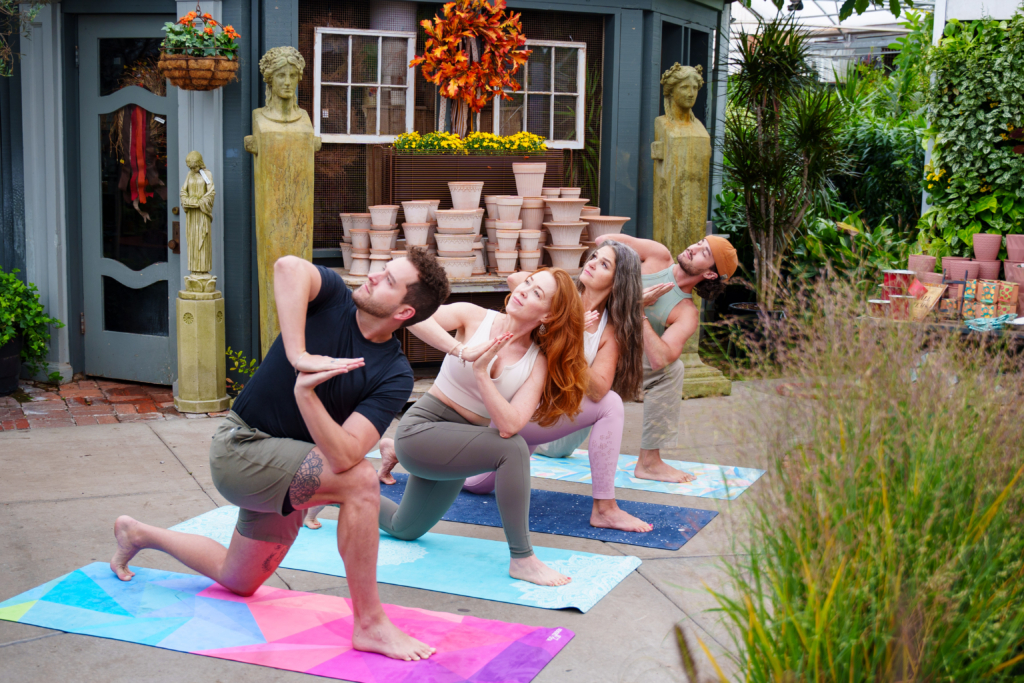
- Place your proper elbow on the skin of your left thigh. If this causes your respiration to grow to be restricted, carry up slightly greater, and place your proper hand on the skin of your left thigh as a substitute.
- In case your elbow is on the skin of your thigh, as within the picture on the prime of this put up, place your arms collectively in entrance of your chest in Anjali Mudra (Prayer Place).
- Breathe and loosen up. You might really feel that your torso needs to maneuver out and in of the twist as you exhale and inhale. Loosen up your pose sufficient with the intention to really feel your physique oscillate in rhythm together with your breath.
- Take 5 to 10 deep breaths.
- Unwind, turning the torso again in order that it’s resting over your left leg.
- Return to Tabletop Pose, Downward Going through Canine Pose or Standing Ahead Bend Pose. Loosen up right here for a couple of breaths to really feel the results of Revolved Lunge Pose.
- Repeat on the opposite facet.
About Charlotte Bell
Charlotte Bell found yoga in 1982 and commenced educating in 1986. Charlotte is the creator of Aware Yoga, Aware Life: A Information for On a regular basis Follow and Yoga for Meditators, each revealed by Rodmell Press. Her third ebook is titled Hip-Wholesome Asana: The Yoga Practitioner’s Information to Defending the Hips and Avoiding SI Joint Ache (Shambhala Publications). She writes a month-to-month column for CATALYST Journal and serves as editor for Yoga U On-line. Charlotte is a founding board member for GreenTREE Yoga, a non-profit that brings yoga to underserved populations. A lifelong musician, Charlotte performs oboe and English horn within the Salt Lake Symphony and people sextet Crimson Rock Rondo, whose DVD received two Emmy awards.

