


This text was initially revealed by Quanta Journal.
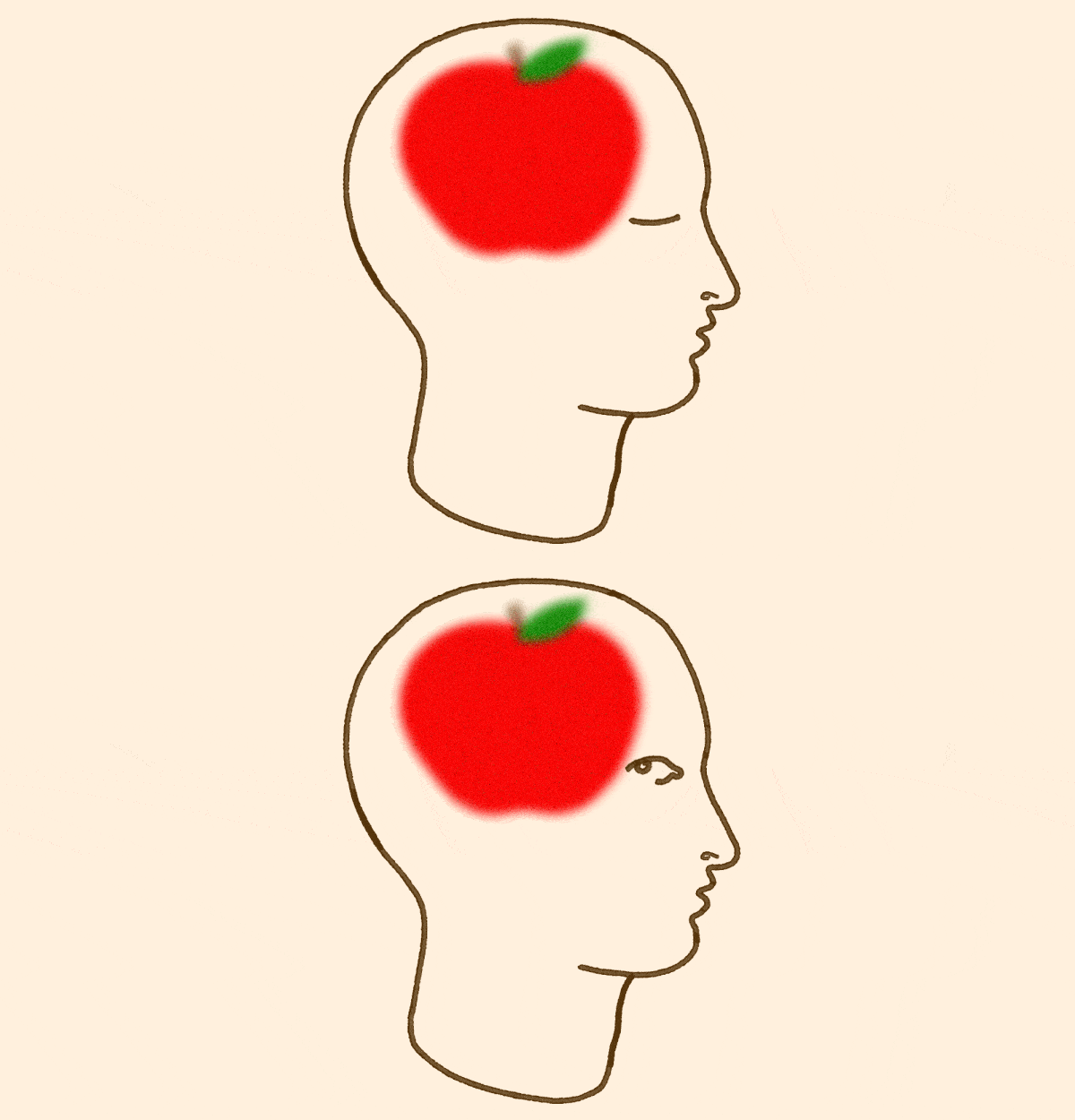
Two years in the past, Sarah Shomstein realized she didn’t have a thoughts’s eye. The imaginative and prescient scientist was sitting in a seminar room, listening to a scientific speak, when the presenter requested the viewers to think about an apple. Shomstein closed her eyes and did so. Then, the presenter requested the group to open their eyes and fee how vividly they noticed the apple of their thoughts.
Noticed the apple? Shomstein was confused. She didn’t really see an apple. She might take into consideration an apple: its style, its form, its shade, the way in which gentle may hit it. However she didn’t see it. Behind her eyes, “it was fully black,” Shomstein recalled. And but, “I imagined an apple.” Most of her colleagues reacted in a different way. They reported really seeing an apple, some vividly and a few faintly, floating like a hologram in entrance of them.
In that second, Shomstein, who’s spent years researching notion at George Washington College, realized she skilled the world in a different way from others. She is a part of a subset of individuals—regarded as about 1 to 4 % of the final inhabitants—who lack psychological imagery, a phenomenon referred to as aphantasia. Although it was described greater than 140 years in the past, the time period aphantasia was coined solely in 2015. It instantly drew the eye of many inquisitive about how the creativeness works.
That included neuroscientists. Up to now, they’re discovering that aphantasia will not be a dysfunction—it’s a special manner of experiencing the world. Early research have urged that variations within the connections between mind areas concerned in imaginative and prescient, reminiscence, and resolution making might clarify variations in individuals’s capacity to kind psychological photos. As a result of many individuals with aphantasia dream in photos and might acknowledge objects and faces, it appears possible that their minds retailer visible data—they only can’t entry it voluntarily or can’t use it to generate the expertise of images.
That’s only one rationalization for aphantasia. In actuality, individuals’s subjective experiences differ dramatically, and it’s potential that completely different subsets of aphantasics have their very own neural explanations. Aphantasia and hyperphantasia, the alternative phenomenon through which individuals report psychological imagery as vivid as actuality, are actually two ends of a spectrum, sandwiching an infinite vary of inner experiences between them.
“We expect we all know what we imply after we speak about what psychological imagery is,” says Nadine Dijkstra, a postdoctoral researcher at College Faculty London who research notion. “However then if you actually dig into it, everyone experiences one thing wildly completely different.” That makes learning aphantasia, hyperphantasia, and different inner experiences troublesome—however removed from unimaginable.
The mind’s course of for creating psychological photos will be described as notion in reverse. After we understand one thing in entrance of us, “we attempt to infer which means from a picture,” Dijkstra says. Electromagnetic waves enter our eyes, are translated into neural indicators, after which circulation to the again of the mind, the place they’re processed within the visible cortex. The data then flows ahead towards the entrance of the mind into reminiscence or semantic areas—a pipeline that ends with us figuring out that we’re a cat or a cup of espresso.
“Throughout creativeness, we principally do the alternative,” Dijkstra says. You begin with figuring out what you wish to think about, like a cat, and knowledge flows from the mind’s reminiscence and semantic areas to the visible cortex, the place the picture is sketched. Nevertheless, that’s a working mannequin of visible creativeness; there’s nonetheless a lot that’s not recognized concerning the course of, resembling the place psychological imagery begins and the precise position of the visible cortex.
These processes had been even much less outlined within the early 2000s, when a 65-year-old man walked into Adam Zeman’s workplace. Zeman, now a neurologist on the College of Exeter who research visible imagery, listened because the affected person recounted how, following a cardiac process, he might now not conjure psychological photos. Earlier than, when he learn a novel, he might see the characters and the scenes. When he misplaced one thing, he might visualize the place it could be. After his process, his psychological stage was empty.
On the time, proof was accumulating that the visible cortex prompts when individuals think about or understand one thing. Zeman puzzled whether or not his affected person’s visible cortex had develop into someway deactivated. He had the affected person lie down in a practical magnetic resonance imaging (fMRI) machine, which measures blood circulation within the mind as a proxy for neural exercise. Zeman confirmed the affected person photos of well-known individuals after which requested him to think about them. Within the scans, the affected person’s visible cortex was considerably lit up solely when he noticed the images. In a 2010 case research, Zeman described him as having “blind creativeness.”
After Uncover journal coated the case research, Zeman heard from a further 20 or so individuals who mentioned that they, just like the affected person, couldn’t visualize photos of their minds. Not like the affected person, nevertheless, these individuals hadn’t misplaced the power. They’d by no means had it within the first place.
Apparently, this was a considerably widespread expertise. In 2015, Zeman consulted a classicist pal to give you a reputation for it. The classicist urged adapting Aristotle’s phrase phantasia, for “thoughts’s eye,” to explain the phenomenon, and the time period aphantasia was born. Quickly after Zeman’s crew reported the shiny new time period, The New York Instances revealed a narrative about aphantasia, triggering a contemporary flood of curiosity. Zeman has now obtained greater than 17,000 messages from individuals eager to be taught extra about their vivid thoughts’s eye, or lack thereof. “Creating the phrases turned out to be an unexpectedly good trick to draw a number of curiosity,” Zeman says.
At dinner tables world wide, family and friends mentioned whether or not they might think about an apple. Philosophers used aphantasia as an excuse to probe explanations for the thoughts. Artwork exhibitions displayed works created by individuals with these extremes in visualization. And scientists dreamed up new methods to check aphantasia as a window into how creativeness works.
Finding out aphantasia wasn’t simple. How do you measure another person’s interior actuality? For years, Shomstein says, analysis “centered on displaying that the situation exists.”
Early research relied on experiences from members—and so they nonetheless do. Probably the most well-known check is named the Vividness of Visible Imagery Questionnaire, created in 1973 to check the energy of psychological imagery, lengthy earlier than aphantasia was named. Nevertheless, such assessments depend on introspection and self-reported expertise, which made some neuroscientists doubt that aphantasia was actual. Might reported variations in visible imagery be a language disconnect, given the paradox in how we describe our interior worlds?
“It could possibly be the case that we’re all really experiencing the very same apple; we’re simply describing it in a different way,” says Rebecca Keogh, a analysis fellow in cognitive neuroscience at Macquarie College, in Sydney, Australia. In 2015, when Zeman coined aphantasia, Keogh was ending her doctorate below Joel Pearson, a cognitive-neuroscience professor on the College of New South Wales. Intrigued, they ultimately designed just a few assessments—one probing the thoughts’s capacity to carry a visible picture, and one other measuring sweat and pupil responses to psychological photos—to verify aphantasia’s existence. Their outcomes confirmed that “it’s not simply that they’re reporting a distinction,” Keogh says. “There appears to be some kind of distinction of their expertise.”
To Cornelia McCormick, a reminiscence researcher on the College of Bonn, in Germany, the concept some individuals don’t have psychological photos was onerous to just accept. However then she grew to become curious. Figuring out that psychological photos are intimately tied to reminiscence, she thought, How on earth do these individuals bear in mind their very own lives? To check this, she and her crew scanned the brains of individuals with and with out aphantasia whereas they recalled private reminiscences.
They discovered that individuals with aphantasia certainly tended to have weaker autobiographical reminiscences and fewer exercise within the hippocampus, which helps encode and retrieve such reminiscences. To their shock, nevertheless, the visible cortex had stronger exercise amongst these people than in individuals with extra typical visible creativeness. McCormick speculated that heightened exercise within the visible cortex might inhibit indicators wanted to drag psychological photos from the background noise.
A rising variety of papers have additionally discovered that aphantasics have exercise of their visible cortex as they think about one thing. Possibly they “have entry to the visible data,” says Paolo Bartolomeo, a neurologist on the Paris Mind Institute, “however someway they can not combine this data in a subjective expertise.” This speculation meshes with the truth that most individuals with aphantasia can acknowledge objects and faces, and plenty of can see photos as they drift off to sleep and of their desires.
“They know what imagery is like from their desires,” Zeman says. However for some motive, they’ve hassle accessing this visible data voluntarily. He puzzled what was taking place of their brains.
A number of years in the past, Zeman scanned the brains of volunteers as they rested in an fMRI machine. The scans urged that, at relaxation, individuals with aphantasia have weaker connections between the mind’s higher-level management facilities (the prefrontal cortex) and its lower-level notion facilities (the visible cortex) in contrast with these with hyperphantasia.
The findings had been broadly supported by a current research, which is at present below peer evaluate, from Bartolomeo’s lab. Bartolomeo and his crew had members lie in mind scanners and actively think about shapes, faces, and locations. In individuals with aphantasia and with out, related areas of the mind activated. Nevertheless, aphantasics confirmed disconnections between the prefrontal cortex and the fusiform imagery node: a area, recognized by Bartolomeo just a few years in the past, concerned in higher-level visible processing.
Taken collectively, the findings counsel that in individuals with aphantasia, the connections between imaginative and prescient facilities and different integrative mind areas differ from these in individuals with out aphantasia. “It is a good declare for some subset of aphantasia,” says Bence Nanay, a philosophical-psychology professor on the College of Antwerp who researches psychological imagery. However chances are high, he says, there are different neural explanations as properly. That might imply that there’s a couple of kind of aphantasia—and certainly a complete spectrum of inner visualization throughout completely different individuals.
Folks with aphantasia report a wide range of experiences. Some can “hear” of their minds, whereas others can’t think about both imaginative and prescient or listening to. Some have wonderful autobiographical reminiscence, whereas many don’t. Some have involuntary flashes of psychological imagery. Many dream in photos, however some can’t. Most are born with aphantasia, though some purchase it after beginning. “Aphantasia will not be a monolithic phenomenon,” Nanay says.
Neither is hyperphantasia. Some individuals with hyperphantasia visualize psychological photos that appear to them as actual because the issues they really see. The pictures that hyperphantasics see aren’t the identical as hallucinations, as a result of they appear to know, on the time, that they’re not actual. However that doesn’t imply they don’t really feel actual.
A subset of individuals with extraordinarily vivid imaginations are referred to as maladaptive daydreamers. Some select to dwell of their creativeness, slightly than in actual life, Dijkstra says. “They sit down on the sofa, they don’t go away their home, they don’t go to high school, they don’t see buddies, they don’t go to their work. They only think about their complete life simply the way in which they need it. As a result of for them, it feels as actual as actuality.”
Regardless of how nascent the analysis is into these imaging extremes, the scientists are likely to agree on one factor: Aphantasia and hyperphantasia aren’t issues. Folks at both excessive of the spectrum usually don’t have issues navigating the world. Aphantasics are sometimes nice at describing issues, Bartolomeo says. When he’s requested them how they’ll visually describe objects or individuals from their reminiscences after they lack psychological photos, he says, they reply: “I simply know.” “It’s only a variant of the conventional mind,” he provides. “There are variants in every thing human.”
Not having psychological imagery might even have benefits. “You may suppose that aphantasia is that this horrible factor … a really impoverished psychological life,” Nanay says. “[But] I actually suppose that when you’ve got aphantasia, you even have one thing to be glad about.” Imagery is commonly deeply tied with psychological well being. It’s potential that individuals with aphantasia are much less prone to have mental-health issues marked by vivid psychological photos, he says. Quite the opposite, when you’ve got hyperphantasia, that threat may improve.
And an absence of psychological imagery doesn’t indicate an absence of creativeness. Zeman has heard from many artists who self-describe as having aphantasia. Shomstein considers herself a artistic and imaginative particular person. Profitable individuals, together with the novelist Mark Lawrence and the software program engineer Blake Ross, a co-creator of the Firefox net browser, have revealed they’ve aphantasia.
“It’s, I believe, as near an honest-to-goodness revelation as I’ll ever dwell within the flesh,” Ross wrote in a 2016 Fb publish about his private discovery. All his life, he had thought “counting sheep” was a metaphor.
For many individuals, it may be jarring to seek out out that they understand the world in a different way from others. Shomstein nonetheless can’t consider that different individuals, with their eyes extensive open, can think about an apricot towards the backdrop of the actual world. “Wouldn’t [that] intrude along with your on a regular basis life?” she asks. “I believe they’re bizarre—in a pleasant manner—and so they suppose that I’m bizarre.”
However actually, everyone’s bizarre, Nanay says. All of us sit on the spectrum between hyperphantasia and aphantasia. It’s not solely potential however possible that you’ve got a very completely different inner expertise from somebody you stroll by on the road.
“The world—as we see it, odor it, hear it, give it some thought—is reconstructed,” Shomstein says. Even a single shared expertise, a thought, a reminiscence, or a easy picture of an apple can appear and feel shockingly completely different on the thoughts’s stage.
So, what do you “see” if you think about an apple?

